Friday, February 22, 2013

Kennedy Space Center - Launch Complex 39


Continuing our early February, 2013, visit to the Kennedy Space Center, we took the first leg of the bus tour from the Visitor Center to the Launch Complex 39 viewing gantry.  On the way to the viewing gantry, we passed the Vehicle Assembly Building (VAB) that was designed for assembling the Saturn V rockets of the Apollo era and reused for stacking the external tank, solid rocket boosters and orbiter of the Space Transportation System (STS), commonly known as the Space Shuttle.  The VAB is 526 feet tall, 716 feet long and 518 feet wide.  To put that in some perspective, that is two regulation football field lengths and three widths including endzones and team areas on the sidelines for a total of six football fields.  The four doors are 456 feet high and take about 45 minutes to open or close.  They are the largest doors in the world.

Just west of the VAB are two of the Orbiter Processing Facilities (OPF) that consists of two adjoining hangar-like buildings.  These buildings have end doors that include a vertical slot for the shuttle's vertical stabilizer.  The third OPF is across the street to the north and is now leased by Boeing for their CST-100 program.

Vehicle Assembly Building and Orbiter Processing Facility
(OPF-1 and OPF-2 are shown)


OPF-3 with the Launch Umbilical Tower that may be used for the
Space Launch System (SLS) in the background


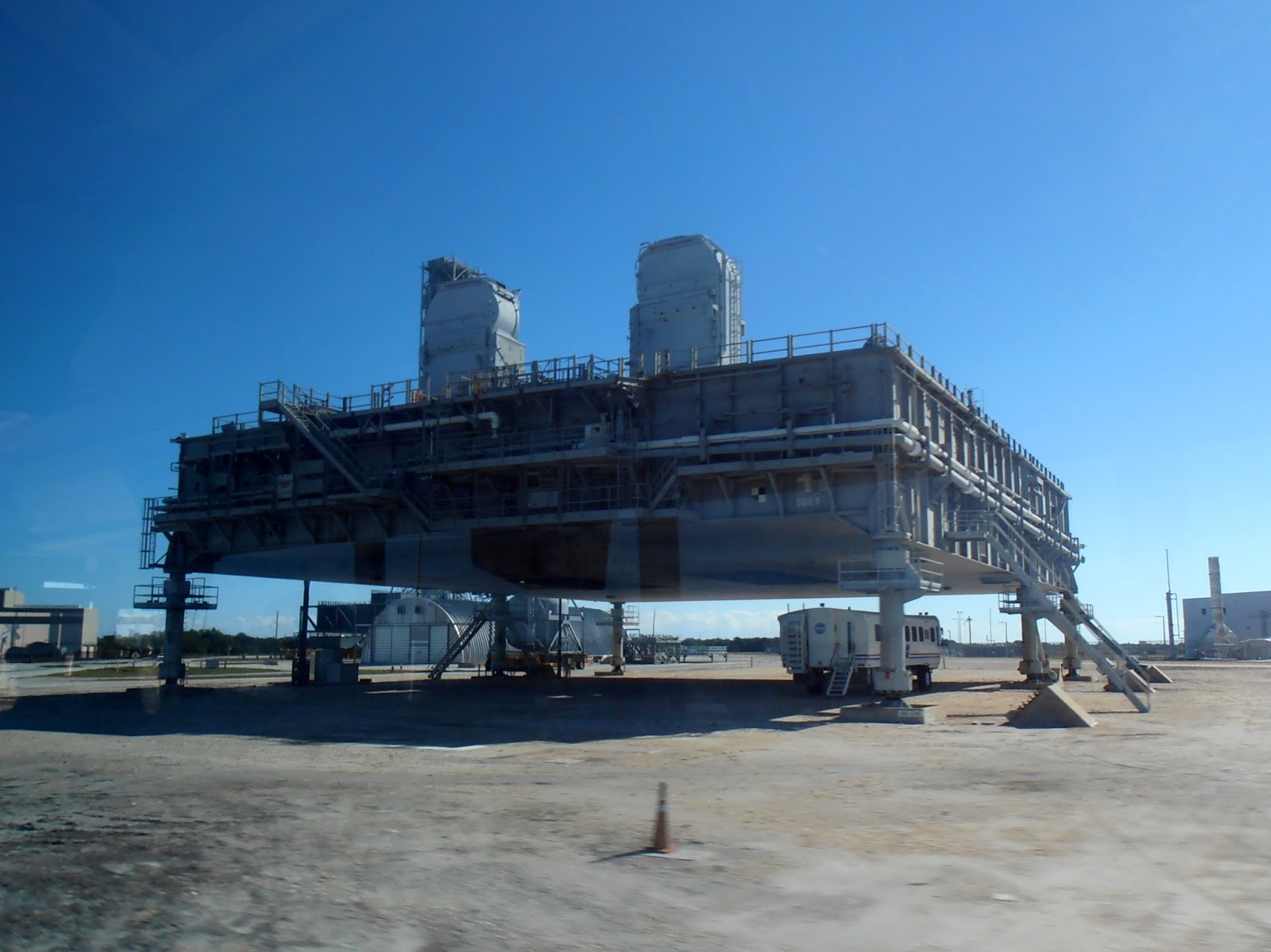
Mobile Launcher Platform (MLP) as modified for the STS program


Mobile Launcher Platform with Launch Umbilical Tower
for the upcoming Space Launch System


Launch Control Complex south (left) of the VAB

The Launch Complex 39 viewing gantry is near the point where the crawler road forks to head to either pad 39-A or 39-B.  From here, we had unobstructed views of both launch pads as well as two unmanned launch complexes across the Banana River on the Cape Canaveral Air Force Station.  Launch Complex 40 is where the Curiosity rover now on Mars was launched on November 26, 2011 on top of an Atlas V rocket.


Launch Complex 39 - Pad B


Launch Complex 39 - Pad A


Launch Complex 40 on left and the Vertical Integration Facility on right


Admission for one day at the Visitor Center and two days to the Astronaut Hall of Fame is $50 for an adult and $40 for children ages 3 through 11.  Admission includes the bus tour and both IMAX® movies.  Parking is an additional $10 per automobile or motorcycle and $15 per motor home.

The Space Center website is http://www.kennedyspacecenter.com.

Thursday, February 21, 2013

Kennedy Space Center - Rocket Garden


In early February, 2013, we visited the Kennedy Space Center in Florida.  Admission includes access to the Rocket Garden, several exhibits, two IMAX® theaters, a bus tour of the Space Center, an amusement park-type ride named the Shuttle Launch Experience®, and the U.S. Astronaut Hall of Fame.  Due to time constraints, we only watched one of the movies and skipped the Astronaut Hall of Fame facility entirely.


For the eyes of the world now look into space,
to the moon and to the planets beyond,
and we have vowed that we shall not see
it governed by a hostile flag of conquest,
but by a banner of freedom and peace.
John F. Kennedy, Rice University, 1962

Rocket Garden

Mercury - Atlas

Gemini - Titan II

Gemini

Saturn 1B (SA-209)

Apollo service arm to White Room

Space Station mural

ORION Crew Capsule (full size model)

Admission for one day at the Visitor Center and two days to the Astronaut Hall of Fame is $50 for an adult and $40 for children ages 3 through 11.  Parking is an additional $10 per automobile or motorcycle and $15 per motor home.

The Space Center website is http://www.kennedyspacecenter.com.

Wednesday, February 20, 2013

Fort Matanzas National Monument


Fort Matanzas was constructed on Rattlesnake Island by the Spanish in 1740-42 to control the "back door" to St Augustine and avoid another lengthy siege similar to that of 1740.  While seemingly lacking in defenses, the fort had a commanding field of fire toward any enemy approaching by water.  Long before a ship could maneuver to train her guns on the fort, the ship would have been under attack from the fort.  Like the Castillo de San Marcos, Fort Matanzas is constructed of coquina.  The fort is 50 feet by 50 feet and had five cannon manned by one officer, four infantrymen and two gunners on month-long rotation from St. Augustine.  The officer had a private room upstairs, below the lookout on the roof.  The men were quartered at the same elevation as the guns.  In 1742, the cannon were used to drive off English scouting boats from a 12 warship flotilla.  This was the only time Fort Matanzas fired on an enemy.

The visitor center was built in 1936 and is listed on the National Regiser of Historic Places.  It hosts a short video presentation about the fort as well as a small gift shop and is also the location for obtaining free tickets to the ferry to the fort.  We visited in early February, 2013.


Visitor Center

Fort from across the river

Fort from the marsh (A rope ladder would have been
the only access, the stairs are for tourist safety)

Men's quarters

View from the barracks window

Officer's quarters

View north from the rooftop lookout

Matanzas River and Rattlesnake Island near sunset

The park website is http://www.nps.gov/foma/index.htm.

Tuesday, February 19, 2013

Castillo de San Marcos National Monument


We visited the Castillo de San Marcos in St. Augustine, Florida, in early February, 2013.  We toured various public areas of the fort and watched an excellent video presentation about the fort.  In addition, we witnessed a group of volunteers firing one of the many cannons mounted on one of the four bastions of the fort.  Adjacent bastions provided overlapping fields of fire that covered the adjoining curtain wall of the fort.  

The fort is the oldest masonry fort in the continental United States.  Although St. Augustine was founded in 1565, the fort was not constructed until over one hundred years later in response to the 1668 attack of the English pirate Robert Searle and the subsequent English settlement of Charles Town, now Charleston, South Carolina in 1670.  Construction began in 1672 and continued for 23 years.  The fort was constructed of a local stone called coquina that was quarried across the harbor on Anastasia Island.  

The fort was besieged by the English in November 1702.  Approximately 1500 residents and soldiers held out for almost two months until the arrival of the Spanish fleet from Havana broke the siege.  During this siege, both sides realized what a fortuitous choice the use of coquina in the construction of the fort had been for the defenders.  The stone is so soft that it absorbed the energy from the cannon fire rather than shatter.  One of the English attackers wrote that it was like firing cannon at cheese.

The fort was attacked again by English General James Oglethorpe in June 1740.  This siege lasted 27 days and included blocking the Matanzas River and all roads in an effort to starve the people of St. Augustine.  However, Oglethorpe's own supplies ran low before those of the 1600 people inside the fort.  

View from entrance bridge

Cannon fire demonstration

Enlisted barracks

External defenses and dry moat

St Augustine lighthouse on Anastasia Island across Matanzas Bay

Imagine 1500 people living in this enclosed space for two months

Log wall extended west to the San Sebastián River

Cannon line

Arched ceilings provided support for cannon overhead

The entrance fee is $7 per person and is valid for seven consecutive days.  If it is available, parking at the lot adjacent to the Castillo is $1.50 per hour with a maximum of four hours.  Additional parking is available several blocks away at the Historic Downtown Parking Facility for a flat rate of $10 per entry.

The park website is http://www.nps.gov/casa/index.htm.

Monday, February 18, 2013

Fort Caroline National Memorial


In early February, 2013, we visited the Fort Caroline National Memorial.  This memorial is near the site, most probably lost to the St. Johns River, of the French settlement of La Caroline.   This was France's first attempt at a permanent settlement in North America.  An exploratory expedition was conducted by Jean Ribault in 1562, but the settlement did not begin until a second expedition landed on June 22, 1564, with approximately 200 people.  In addition to seeking gold for France, the colony was to be a refuge for the French Huguenots.  In 1565, an additional 600 French soldiers and settlers arrived.  By this time, the Spanish had learned of the settlement and planned to force the French out.  The Spanish reinforced St. Augustine in preparation for an attach on La Caroline.  The French went on the offensive and sailed down the coast to attack St. Augustine.  However, a hurricane scattered the French fleet and forced them far down the coast.  Seizing the initiative, Admiral Pedro Menédez marched 500 men north.  On September 20, his troops massacred 140 settlers leaving only approximately 60 women and children.  Menédez then marched his men south to find the shipwrecked Frenchmen.  The French threw themselves on his mercy, but to him they were heretics and enemies of his king.  Menédez's men killed about 350 men at a place later named Matanzas (slaughter).  The French made one additional foray into Florida in 1568, attacking the fort and killing everyone defending it, but they never seriously challenged Spanish claims in Florida again.

Although rather small, the visitor center has an excellent display entitled "Where the Waters Meet."  As we have come to expect, the volunteer on duty was both friendly and knowledgeable.


Visitor Center

While the original site of the settlement and fort have been lost over the centuries, a fort exhibit has been constructed at the memorial based on drawings made by French mapmaker, artist and settler Jacques le Moyne de Morgues.  The fort exhibit contains approximately one-third the area of the actual fort and was constructed by the National Park Service in 1964 for the four hundredth anniversary of the establishment of la Caroline.  The nearby Timucuan shelter is also an approximation based on French and Spanish records.  While once numbering in the tens of thousands and having lived in the area for hundreds of years, only 550 Timucua were recorded in the Spanish records of 1698.


A 1.3 mile loop trail leads from the visitor center to the Timucuan exhibit and fort before winding through an oak and pine forest before returning to the parking lot.  In addition, there is a boardwalk out to a modern dock for visitors arriving by water.  There are also a series of trails to the east and south of the visitor center into the Theodore Roosevelt Area of the 46,000 acre preserve.


Timucuan exhibit along the trail


Fort Caroline from the St Johns River


Fortified side of fort toward land


Moat surrounding fort


Interior of fort

Cannon facing threat from land

Wooden fort wall along river

Nature trail includes pine trees and saw palmetto

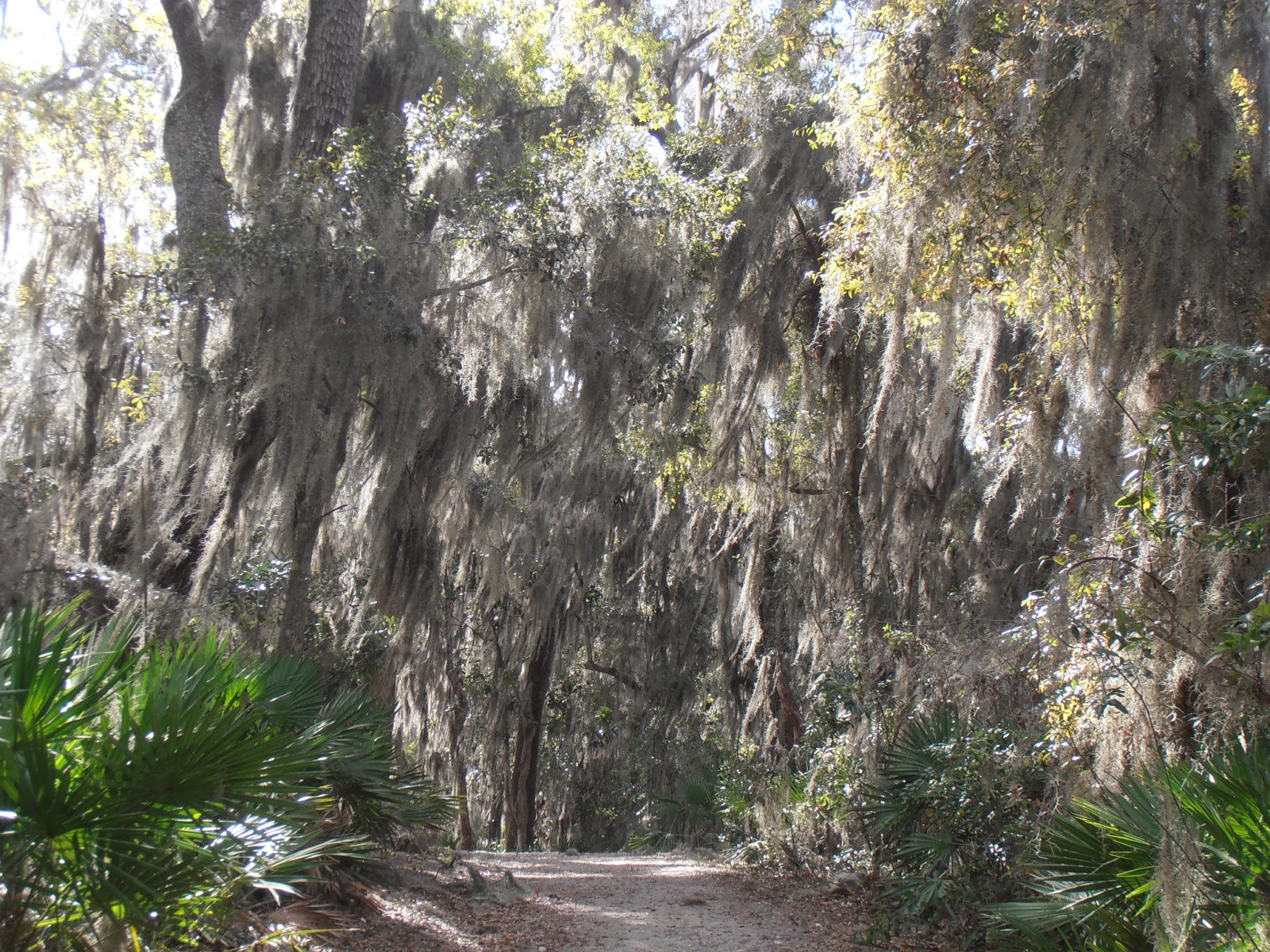
Nature trail also includes live oaks and Spanish moss

There is no entrance fee to visit the park.

The park website is http://www.nps.gov/foca/index.htm.

Sunday, February 17, 2013

Napoleon Bonaparte Broward Bridge


While driving to Fort Caroline and the Timucuan Ecological & Historic Preserve in Jacksonville, Florida, in early February, 2013, we crossed this beautiful engineering structure on Interstate 295 East Beltway.  It was so stunning that we decided to cross back over the St. Johns River in order to take some pictures.  Please note that my wife was driving while I took the pictures.

View from the sidewalk of Fort Caroline Road

Approaching the cable-stayed section of the bridge

The white cables nearly glow
against the gray concrete and gray sky

The bridge is also known as the Dames Point Bridge.  It is a six-lane cable-stayed bridge over the St. Johns River.  Construction took four years and was completed in spring 1989.  The main span is 1300 feet and it provides 175 feet of clearance above the river.