Monday, March 4, 2013

Along the Main Park Road - Everglades National Park


I haven't found a listing of locations along the Main Park Road by mile marker and that may be because there are no mile posts along the route.  However, I put together the following list to help us judge how much time we needed to allow to drive from one place to the next.  These distances are only approximations and do not include the drive off the main road to the parking area, which can be nearly two miles.


Location
Mile
Flamingo
0.0
Bear Lake Road
0.5
West Lake
7.0
Ninemile Pond
11.5
Paurotis Pond
13.5
Mahogany Hammock
18.0
Shark River Slough pull out
19.7
Dwarf Cypress Forest
23.5
Pa-hay-okee
25.1
Rock Reef Pass
26.6
Long Pine Key
33.4
Royal Palm Key
35.6
Ernest Coe Visitor Center
37.7
Park Boundary
38.3

I've already posted information about some of these locations and we did not find time to visit all of the others during our visit in early February, 2013.  The park has an entrance fee of $10.00 per car that is valid for seven days.  The following is just a small sample of the many things that can be seen during the dry season while driving to some of the more popular locations in the Everglades.


Paurotis Pond


Paurotis Pond is one of several rookeries in the park

Calm water 

American Wood Stork

Shark River Slough pull out


While this may look like a mid-western prairie,
the ground is covered in water

A pair of cypress domes

Pineland areas are rare due to the seasonal flooding


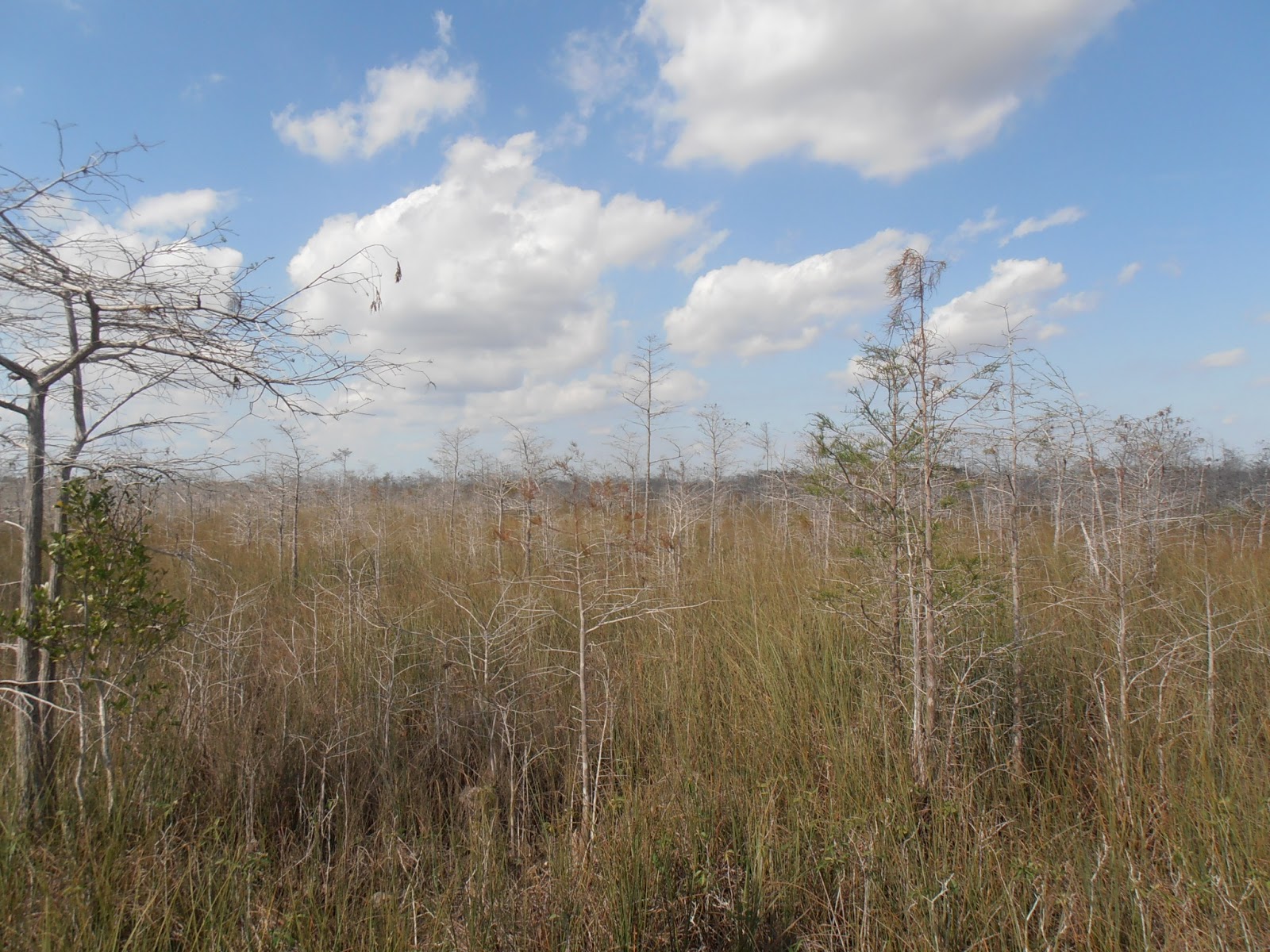
Dwarf Cypress Forest


A small elevation change has a huge impact in the Everglades

Dwarf cypress trees are deciduous conifers

Cypress trees yield to pines as the elevation increases

A few cypress still had needles this late in the dry season


Pa-hay-okee


From the elevated viewing platform,
the saw grass seems to be endless

Still on a boardwalk, but closer to the ground

Looking back at the elevated boardwalk reveals a variety of habitats

Buttressed trunks help cypress tress withstand floods


Rock Reef Pass


Rock Reef is the "ridge" that separates Shark River Slough
on the west from Taylor Slough on the east

Saw grass in Taylor Slough

Looking northwest at the tree line that marks
the higher elevation of Rock Reef

Looking south along Rock Reef

The main park road is also known as Ingraham Highway and FL 9336

The park website is http://www.nps.gov/ever/index.htm.

Sunday, March 3, 2013

Ninemile Pond - Everglades National Park


During our early February 2013 visit to the Everglades, my wife signed us up for a ranger-led morning canoe trip in the Flamingo area of the park.  We arrived at the Ninemile Pond parking area and found our names were not on the ranger's list.  However, he was willing to work with us and mentioned he had a couple of kayaks that weren't being used.  When he found out that we were novices, he decided to put us in one of the canoes instead.  The group waited about 10 minutes for the final couple to arrive, but they never did.  After realizing that some of the other names on the list weren't exactly correct either, he deduced that we probably were the missing couple and strapped the kayaks back on the trailer.  


I should have taken the roster mix up as a sign and bowed out of the trip, but Joan had her heart set on making this trip, so we forged ahead.  The ranger told us to push the canoe mostly into the water with just the stern on the shore and for me to sit in the front of the canoe and my wife to sit in the back.  I climbed in, sat down and waited for further instructions.  My wife also got in the canoe.  The ranger then said that he'd help push us off the bank.  The next thing I knew, the canoe was slowly rolling to the left and I was quickly dumped into the pond.  I had no idea that I could get completely soaked in about 15 inches of water.  Luckily, my camera was in its pouch on my right side, so it didn't get wet.  I looked back and Joan was soaked as well, but only on her left side as she was only in six inches of water.  The ranger and I dumped the water out of the canoe and we boarded it again without incident.  Once we had paddled a few feet off the bank, I realized that I hadn't asked Joan how long we would be paddling.  For some reason, the theme song to Gilligan's Island popped into my head when she told me it was either a 3 or 3½ hour trip.  


While the ranger led the group, a couple in their own kayaks volunteered to trail behind.  As we were the last of the six canoes in the water, we were at the back with the kayaking couple, Bill and Phyllis.  Bill was a constant source of encouragement to us during the entire trip.  Most of the trip was spent paddling in very shallow water through the mangroves.  We had to wait a couple of times for alligators to swim away before proceeding.  


Red Mangrove

Bladderwort is visible in the shallow water

Mangrove thickets can be very dense

Alligator swimming toward the mangroves
(and away from us!)


Reflections in calm water

Mangroves with some saw grass

Catopsis (an epiphytic bromeliad) growing in a fork in a mangrove

Air boats disrupted this part of the ecosystem many years ago


Saw grass almost hides an alligator

Finally back to open water
As we neared the end of the tour, I was ready to head for the bank.  However, I quickly reconsidered when the ranger pointed out "Croczilla", the resident twenty-foot crocodile that was sunning at the edge of the pond.  We stopped about fifty feet away and I took some pictures.  When the crocodile opened its mouth to pant, Joan told me to get her out of there immediately!  However, the ranger had other ideas and gathered us together at the edge of the mangroves to inform us that alligators are seldom aggressive toward humans, but that crocodiles can be quite aggressive.  At this point, Joan found her second wind and paddled like there was no tomorrow.

Twenty foot long crocodile

Crocodile panting to regulate heat

Little Blue Heron at edge of saw grass

With an alligator sunning at our take out area,
we paddled to the other end of the parking lot

In spite of our inept canoeing, this was an excellent ranger-led activity that was one of the highlights of our trip.

The park website is http://www.nps.gov/ever/index.htm.

Saturday, March 2, 2013

Florida Bay Boat Tour - Everglades National Park


While in Flamingo on our visit to the Everglades in early February, 2013, we bought tickets for the Sunset Cruise at the marina.  The hour and forty-five minute pontoon boat cruise is operated by a concessionaire of the park and explores a small portion of Florida Bay.  Tickets are $32.25 per adult and $16.13 for those ages 5 to 12.  Children under five can ride for free.  The crew consisted of two young men.  We were rather disappointed in the cruise and in the crew's lack of knowledge about the wildlife.  When one guest asked how dolphins breathe, she was told by the mate that "it's not a lung like ours are."  The captain did know the names of the various keys that we passed, such as Bradley, Murray, Frank, Catfish and Oyster Keys.

Tricolored heron preening on a red mangrove branch

Little Blue Heron

American White Ibises

Two ospreys nesting in a solitary red mangrove

Another pair of ospreys nesting on a navigational marker

Mangrove keys


Dolphin swimming alongside the boat

The crew let the boat drift while waiting for the sun to set

The end of a beautiful day on Florida Bay

The concessionaire website is http://evergladesnationalparkboattoursflamingo.com/index.php.
The park website is http://www.nps.gov/ever/index.htm.

Friday, March 1, 2013

Eco Pond - Everglades National Park


Eco Pond is a freshwater pond located just west of the Flamingo Visitor Center near the end of the road at Florida Bay in the Everglades.  A half-mile trail loops around the pond and provides numerous opportunities to view wildlife including a variety of birds.  This was the perfect place to get out and stretch our legs for a bit.


The trail around Eco Pond is a wide, grassy swath

Tricolored Heron

While not readily visible in the pictures, the trees are covered with birds

The only remaining boardwalk out the pond

Coastal prairie

View of the island from the only bench along the trail

The park entrance fee is $10 per vehicle for seven consecutive days.
The park website is http://www.nps.gov/ever/index.htm.