Showing posts with label National Register of Historic Places. Show all posts

Thursday, December 30, 2021

Lake McDonald Lodge - Glacier National Park

Leaving the boat tour of Lake McDonald, we climbed several flights of stairs to the Lake McDonald Lodge. While we didn't stay at the lodge, we did have the opportunity to visit most of the public spaces in the historic landmark. Constructed in 1913-14, the Swiss-chalet-style lodge opened in June 1914, predating the construction of the Going-to-the-Sun Road by several years. Early travelers had to ride a steamboat from the Apgar area to the lodge, so it was designed with the front facade facing the lake. Since 1921, visitors have arrived by motoring up the Going-to-the-Sun Road and entering the lodge through the back door.

In addition to the lodge, there is a row of cabins and a dormitory building that was remodeled into hostel-type housing bring the total number of guest rooms to 82. 

During our visit in May 2021, the dining room was closed due to COVID-19, but a limited menu of take-out food was available. The food quality was just average and the prices were on par to a bit higher than those outside the park. A large parking lot spans most of the area between Going-to-the-Sun Road and the lodge, but it quickly filled up as the day progressed.

Mount Gould (9553') from the lakeshore

North wing of Lake McDonald Lodge

Center of the lodge and the main entrance

South wing

Lobby

Gift shop

Huge fireplace

Second- and third-floor balconies

Lobby lanterns

Originally the rear of the lodge, now the street or main entrance

A Glacier National Park entry fee of $35 per vehicle, $30 per motorcycle, or $20 per person is valid for seven consecutive days. Other fee payment options include the America the Beautiful - National Parks and Federal Recreational Lands passes including the Annual Pass ($80), Senior Pass ($80 for a lifetime), Access Pass (free with a documented disability), and Military Annual Pass (free for active-duty personnel). Also available is a Glacier Annual Pass for $70.

The Glacier National Park website is https://www.nps.gov/glac/index.htm.

Saturday, December 25, 2021

Camas Road - Glacier National Park

The Camas Creek Cutoff Road, also known as Camas Road, is an 11.7-mile two-lane paved road between the Going-to-the-Sun Road at the Apgar Visitor Center in Glacier National Park and North Fork Road in the Flathead National Forest. Construction on the road began in 1960 and was completed in 1967 at a cost of $2.5 million. It was originally intended to be part of a proposed International Loop Road that would connect Glacier National Park with Canada's Waterton National Park. Ultimately, Camas Road was the only portion of the route that was ever constructed. 

The route has two major bridges with one over McDonald Creek and the other over the North Fork Flathead River. The McDonald Creek bridge is located ½ mile northwest of the Going-to-the-Sun Road intersection and the North Fork Flathead River Bridge is near the other end of the route just 0.2 miles from North Fork Road. Except for the northwestern-most 0.2 miles beyond the North Fork bridge located in the Flathead National Forest, nearly the entire route is within Glacier National Park. 

Near the Going-to-the-Sun Road intersection, the road provides access to the village of Apgar, the Fish Creek Campground, and Rocky Point and Lake McDonald trails. Further northwest, it provides access to the Huckleberry Lookout Trail and the Forest and Fire Nature Trail, formerly the Huckleberry Mountain Interpretive Trail.

We visited this western side of the park in May 2021.

Mount Cannon (8952'), Mount Brown (8565'), Edwards Mountain (9072'),
Gunsight Mountain (9258'), and Mount Jackson (10052')

A closer look at Mount Jackson

McGee Meadow

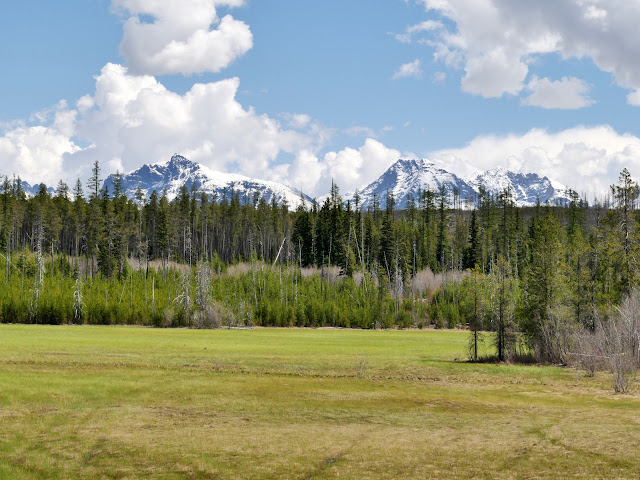
Mount Vaught (8850') and Stanton Mountain (7750') from McGee Meadow

Mount Brown, Edwards Mountain, and Gunsight Mountain from McGee Meadow

Apgar Mountains from the Huckleberry Mountain trailhead

A Glacier National Park entry fee of $35 per vehicle, $30 per motorcycle, or $20 per person is valid for seven consecutive days. Other fee payment options include the America the Beautiful - National Parks and Federal Recreational Lands passes including the Annual Pass ($80), Senior Pass ($80 for a lifetime), Access Pass (free with a documented disability), and Military Annual Pass (free for active-duty personnel). Also available is a Glacier Annual Pass for $70. 

The Glacier National Park website is https://www.nps.gov/glac/index.htm.

Friday, November 26, 2021

USS Laffey (DD-724) - Patriots Point


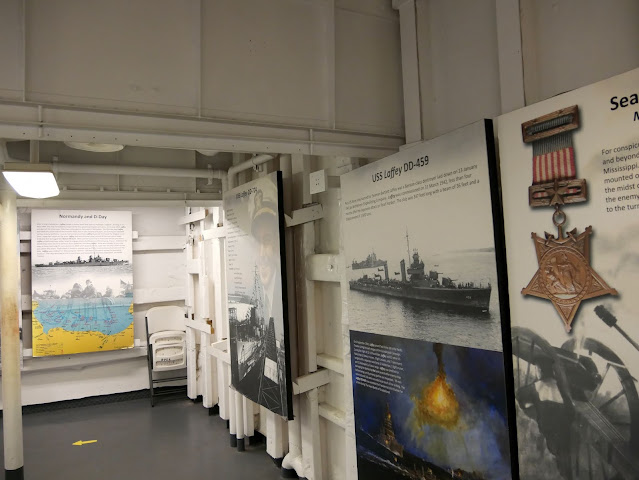
Continuing my day at Patriots Point during our February 2021 trip to Charleston, I toured the USS Laffey (DD-724). Nicknamed "The Ship That Would Not Die", the destroyer served both in Europe and the Pacific. Completed just in time to support the Allies D-day landings in Normandy, the Laffey escorted tugs and landing craft bound for Utah Beach. After performing screening duties and even shore bombardment, the Laffey was on her way back to the States in early July 1944. After a month long refit and subsequent shakedown cruise on the east coast, she headed for the Pacific by way of the Panama Canal. By September, the Lafferty was in Pearl Harbor. She joined Task Force (TF) 38, screening for carriers involved in the aerial bombing of strategic targets in the Philipines. After supporting the December 15 Allied landings on Mindoro, she supported the January 1945 landings in the Lingayen Gulf area of Luzon. In early March, the Laffey spent three weeks in intensive training with the battleships of TF 54 before sailing with the TF to support the invasion of Okinawa. On April 15, 1944, the Laffey was assigned to radar picket station 1 about 30 miles northwest of Okinawa.
 
Over the course of about 80 minutes on the morning of April 16, USS Laffey was attacked by approximately 30 Japanese airplanes. The Laffey fought well through what has been called one of the, if not the most, unrelenting suicide attacks of the war.

As noted in the Presidential Unit Citation for USS Laffey:
For extraordinary heroism in action as a Picket Ship on Radar Picket Station Number One during an attack by approximately 30 enemy Japanese planes, thirty miles northwest of the northern tip of Okinawa on 16 April 1945. Fighting her guns valiantly against waves of hostile suicide aircraft plunging toward her from all directions, the USS LAFFEY set up relentless barrages of anti-aircraft fire during an extremely heavy and concentrated air attack. Repeatedly finding her targets, she shot down eight enemy planes clear of the ship and damaged six more before they crashed on board. Struck by two bombs, crash-dived by suicide planes and frequently strafed, she withstood the devastating blows unflinchingly and, despite severe damage and heavy casualties, continued to fight effectively against insurmountable odds, and her brilliant performance in this action reflects highest credit upon herself and the United States Naval Service.

For the President,
James Forrestal
Secretary of the Navy

Out of a complement of 336 officers and crew, 32 were killed and 71 wounded in the attacks. 

The Laffey also served with distinction during the Korean War, earning another two battle stars to go with the five earned in World War II. Decommissioned in 1975, the Laffey was acquired by Patriots Point in 1981. The USS Laffey is listed on both the U.S. National Register of Historic Places and as a U.S. National Historic Landmark.


Adult entrance to the museum is $27 and includes access to the USS Yorktown and USS Laffey as well as the Vietnam Experience and the Medal of Honor Museum. The USS Clamagore was closed to visitors due to Covid-19 restrictions when I visited the museum. Other tickets are available for active duty, retired military, veterans, first responders, teachers, seniors, and children. An adult annual pass is $69. Discounts for an adult ticket are often available online, but not on the museum website.

The museum website is https://www.patriotspoint.org/.

Wednesday, September 6, 2017

Paul Bunyan Park - Bemidji, Minnesota


Bemidji, Minnesota bills itself as the "First City on the Mississippi" as well as the birthplace of the legendary lumberjack, Paul Bunyan. We stopped at Paul Bunyan Park to check out both claims during our August 2017 visit to the state.

The headwaters of the Mississippi River are just a few miles out of town in Itasca State Park, but nearly 60 river miles upstream. The river flows through Lake Irving and Lake Bemidji before wandering over 400 miles to Minneapolis.

The park has a large parking area with over 100 spaces for passenger cars. Entry to the parking area is at Second Street and Bemidji Avenue. The exit is a block north at Third Street and Bemidji Avenue. Finding the park from the north was a bit of a challenge as I didn't see any informational signs along US-71. The easiest way to get to the park from out of town is to take the Division Street exit from US-2 / US-71. Follow Division Street east 1.7 miles as it becomes Fifth Street. Turn south on Bemidji Avenue and drive three blocks to the parking entrance on the left at Second Street.

With a population of over 14,000 people, Bemidji truly is the first city on the Mississippi River. With dozens of lakes, numerous bike paths and trails, a state park and a state forest, the Bemidji area should be on your list of stops in the North Woods of Minnesota.

The park is across the street from downtown

Chamber of Commerce and Visitor Center

Information desk

Brochures for area attractions

The fireplace is composed of stones from near and far

Souvenir clothing and exhibits

Eighteen foot tall Paul Bunyan and ten foot high Babe the Blue Ox

Rotary Pavilion

Lake Bemidji

Black-eyed Susans

Another view of the lake

Playground

Niiemii - "he dances"

Parking and entry to the park are free.

The visitor center website is http://www.visitbemidji.com/.

Monday, May 16, 2016

Abandoned Buildings of the Elkmont Historic District - Great Smoky Mountains National Park


Elkmont is located in the Little River and Jakes Creek valleys on the Tennessee side of the Great Smoky Mountains National Park. A pioneer community in the 1840s, it became a logging town in the early 1900s, and a resort community for the affluent in the 1910s. When the National Park was established in 1934, many of the resort cottage owners were given lifetime leases. The leases were converted to 20 year leases in 1952 and renewed in 1972. In 1992, most of the leases expired and the park announced plans to remove the Wonderland Hotel and all the cottages. Before the park service could act, the hotel and many of the cottages were listed on the National Register of Historic Places as the Elkmont Historic District, Great Smoky Mountains National Park. Over the next 15 years, various stakeholders vigorously debated the future of the historic structures. During that time, the Wonderland Hotel collapsed due to structural failure likely due to rainwater leaking into the building. The park service has restored the Appalachian Clubhouse and has plans to restore over a dozen of the most significant structures as funding allows. In the interim, the lack of maintenance is obvious and signs have been posted warning visitors not to enter the buildings. Below are pictures from late April 2016 of some of the structures built along Jakes Creek.


Entry to Great Smoky Mountains National Park is free.

The park website is http://www.nps.gov/grsm/index.htm.